
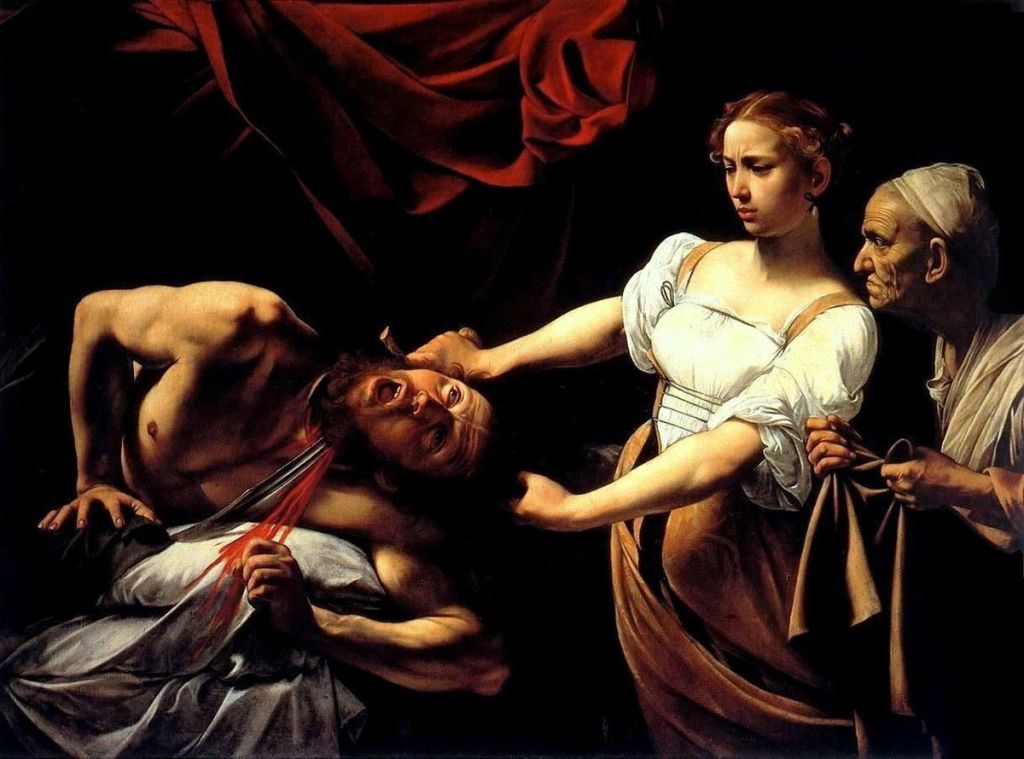
(Image: Judith and Holofernes.)
Crime and Punishment by Fyodor Dostoyevsky is a masterpiece that deserves to be read at different stages of life. The summary of the book cannot be derived from a few words; however, it reminds me of the South Korean movie, “Spring, Summer, Autumn, Winter.” and my recent read “Animal Farm” by George Orwell.
Crime and Punishment raises important questions about the nature of crime and the way society deals with these issues. For the most part, the novel is a finely crafted crime story. While the first few pages are detailed and the literature is heavy for the eyes, it becomes easier after the murder.
Dostoyevsky, wrote the novel at a time when Europe was beginning to question the existence of religion and its investment in social structure. A subject we can relate to in the present. Crime and Punishment elaborates on many relevant questions, like what would become of a society without religion and if the moral values that have been passed on through the decades were changed. What kind of existential questions would come up if dogma and the rigid social structure were destroyed before a new one was established?
Raskolnikov, a destitute boy in rags, eating scraps, and living in the slums of St. Petersberg, is prone to bouts of monomania and depression. He decides to kill an elderly pawnbroker after he pretends to want to pawn his watch, later trying to justify it and then repenting. Raskolnikov dreams of a particular scene from his childhood where there is a tavern near his church. A group of villagers have gathered on a horse-driven cart. This horse, is an old, weak and weathered-down entity who is finding it difficult to pull the cart with many peasants boarding it. Observing the cart moving slowly and the horse straining as it inched forward, the horse’s owner asks his men to beat the horse up with the intention of hurrying the horse. However, the horse struggles even further. The owner, instead of paying heed to the horse’s struggles, urges the men to beat the horse further. This unfolds a very violent spectacle for both the characters in the book, and the reader. I had to, for a moment, keep the book down and reach for it only when I could compose myself.
What started as a mere punishment for the horse to encourage him towards a particular act is now manifested as a desire of the peasants to watch with pleasure as the horse writhes in pain. The passersby cry out for mercy, “You’re not a Christian!” at the owner and the peasants, who are now far removed from moral values and conscience. The peasants and the owners, exhaust themselves, enjoying beating the old horse to death.
In this dream, Dostoevsky illustrates the stark evil our thoughts can create that can bear an extraordinary resemblance to reality. What’s morbid about the dream is not that it was composed in his brain but that its manifestations are seen around us. It questions our motivations and moral code of conduct, which we announce on beat boxes so profoundly as saintly and holy.
Dostoevsky, in some ways, prophesied our current social state. Nietzsche had a similar dream once, where a horse was beaten to death. He was so disturbed that he ran out of his house in the middle of the night, hugged his horse and cried, begging for forgiveness. He never recovered from it.
The beating of the horse is a symbolic aspect of the book. The violation of the wretched and the pleasure derived from conducting rageful acts merely because there aren’t any consequences against it is a terrifying idea. How the society gathers to celebrate and give it a moral code are the disturbing factors of the society. Can religion then exercise its moral code to protect these hapless souls, or will it justify it, adding some fuel?
This is a new non-religious order within the framework of religion that exists under the farce of a complaint and a self-righteous society. It creates a terrifying world in which morality doesn’t exist for men. It exists as free will, only to be exercised by those who can sway the mob to do the flogging.
When Raskolnikov wakes up from his dream, terrified of what he just saw, he is gasping for air, his hair soaked in sweat. He jumps out of bed, assured that it is only a dream.
“Thank God, that was only a dream… Such a hideous dream!” he says.
The terrifying part of this horrific dream is that it is not a dream. Many years later, moral foundations have collapsed in each decade, allowing societies to rationalise and ideate crimes against humanity. Setting up death camps to exterminate entire races of people, just because they don’t belong or were found to not align with their religious and moral code, has resulted in launching a full-scale hatred towards a section of the human race, motivated by spite. If you don’t align with their moral and religious values, you are an invalid. At the center of the ring is an old man, asking the peasant to flog the old horse.
"Kill her, take her money and with the help of it devote oneself to the service of humanity and the good of all. What do you think, would not one tiny crime be wiped out by thousands of good deeds? For one life thousands would be saved from corruption and decay. One death, and a hundred lives in exchange—it’s simply arithmetic! "... excerpt from the book - Crime and Punishment.
This quote expresses the arguments provided in support of the crime. If the justifications have a high moral value, then the crime becomes legitimate and easier to communicate. The important question is, if we think the murder of the innocent, whether it is a horse or a calf butchered in the middle of the street, even if you hate them, can be justified as an argument for a deed? Can a crime be rectified by attributing it to the well-being of hundreds? Life is sacred and not to be subjected to an ever-changing moral code. There is no moral or religious justification for the calling of cruelty. Life is precious and should be protected.
Crime and Punishment, has been a subject of my study for a long time, and therefore today I have chosen to write about what I often think about, the kind of disturbing mindset society can manifest if law and order were to be removed. Such crimes against morality still seem to be executed regardless. Be it the slaughtering of a newborn calf on the streets of Tamil Nadu by a political party to hurt the integrity of another faction, to dare in their faces, “We’ll eat BEEF BIRYANI!” Or to make an example or martyr out of an individual to create a precedent. It is rationalised by seculars and intellectuals with statements like, its their right to cuisine, etc.. or in the name of God. The important thing to note here is the intention of the crime and the victim of the crime: an innocent new-born calf, oblivious to the world he enters, and far removed from his mother who pines for him from her shed. Making it an absolute hell show. Like Nietzsche waking up in the middle of the night with dreams of the old horse, and so I wake up visualising a bloodthirsty mob, led by a leader clad in pure white, caliing for the death of a frightened baby, in the middle of a crowd tonfrightened and venge a third party. The petty agreeable peasants with their red eyes and drooling lips, chanting death, with weapons in their hands looking to strike and devour, to enjoy the shit show because there are no consequences.
written by Puja Goyal, February 28, 2024


Leave a comment